MCC’s Second Compact Takes Shape as Liberia Targets Power, Mining and Institutional Reform
MONROVIA, Liberia — Liberia’s drive to secure a second Millennium Challenge Corporation (MCC) Compact has entered a critical project-design phase, with the government focusing its development strategy on transforming the energy sector, unlocking the country’s mineral wealth and strengthening institutions to sustain long-term economic growth.
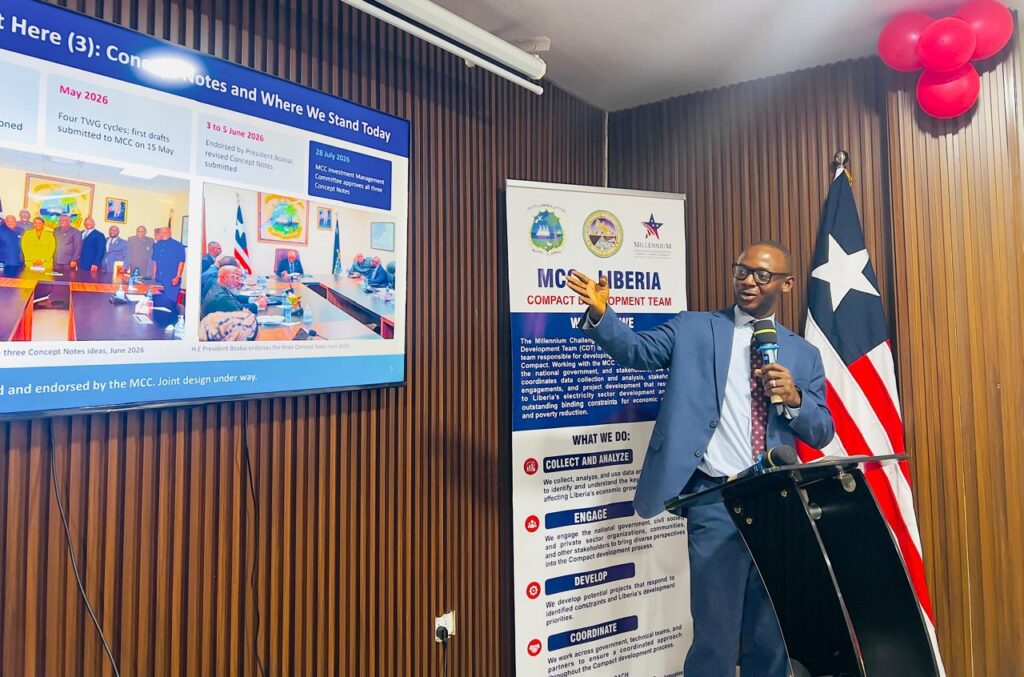
The latest development came on Thursday, September 17, 2026, during the official opening of the MCC-Liberia Compact Development Team (CDT) office in Monrovia, where government officials outlined progress toward the country’s second Compact.
The proposed Compact is being developed under the theme: “Powering Critical Industries. Unlocking Liberia’s Mineral Wealth. Building the Institutions to Sustain Both.”
National Coordinator of the Compact Development Team, Alieu Fuad Nyei, said the initiative is based on a government-led assessment of the major constraints limiting Liberia’s economic growth.
According to Nyei, the assessment identified inadequate energy supply, poor road infrastructure, limitations in port facilities and weaknesses in the quality of education as some of Liberia’s binding constraints to economic growth.
He said other challenges include a weak business regulatory environment, gaps in legal and institutional frameworks, and inadequate data systems for coordination and information sharing.
“Economic growth is central to reducing poverty because a growing economy creates opportunities for businesses, expands employment and increases government revenue,” Nyei said.
He explained that the second Compact is therefore intended to address the structural barriers preventing Liberia from fully converting its natural and human resources into broad-based economic opportunities.
Energy at the Center
At the heart of the proposed Compact is an ambitious Energy Sector Transformation Project, which officials say will go beyond expanding electricity access to ensuring that reliable and affordable power reaches productive economic activities.
Nyei said Liberia’s electricity challenge must be addressed in a way that directly supports industries, particularly mining, agriculture, agro-processing, small businesses and other enterprises along expanded electricity corridors.
“Reliable and affordable electricity has the potential to reduce operating costs for mining companies, increase production and generate greater economic activity and government revenue,” he said.
The proposed intervention will focus on transmission infrastructure, electricity-sector governance and workforce development, combining physical infrastructure with institutional reforms.
Nyei said the CDT is currently assessing proposed transmission corridors, including eight lines and eight substations. Areas under consideration include Virginia, Clay, Paynesville and other locations, while the P-Zero substation has been identified as a major hub in the proposed network.
The transmission expansion is also expected to consider a major line connecting Buchanan to Monrovia, as well as a potentially extensive corridor extending toward Maryland County.
The objective, Nyei said, is to provide more reliable electricity to areas with significant mining, agricultural, food-processing and industrial potential, thereby supporting economic activity beyond Monrovia.
But officials say the energy component will not focus on infrastructure alone.
Nyei identified revenue protection, utility financial management, transmission capacity, workforce skills and generation financing as among the structural challenges that must also be addressed.
“A utility cannot remain financially viable if it is unable to collect electricity bills, while weak transmission infrastructure prevents available power from reaching areas where it is most needed,” he said.
The proposed reforms include a modern and predictable electricity law, clearer rules for independent power producers, greater clarity on private-sector participation—particularly in distribution—and stronger integration of Liberia into the regional electricity market.
Such regional integration could allow Liberia to purchase electricity from neighboring countries when domestic supply is insufficient and potentially sell electricity when the country has excess generation.
The CDT is also working alongside the Liberia Electricity Corporation’s least-cost power planning process to ensure that future investments are aligned with the country’s broader electricity master plan.
Another priority is improving the financial position of the electricity utility through better metering, revenue protection, credible financial records and the migration of government institutions from post-paid to prepaid electricity arrangements.
Modernizing Liberia’s Mining Sector
The proposed Compact also places significant emphasis on Liberia’s mining sector, particularly the legal, regulatory and geological systems underpinning investment in the industry.
Nyei said Liberia’s mining legal framework requires comprehensive modernization, noting that the existing mining law is more than two decades old despite significant institutional and regulatory changes since its adoption.
Although Liberia adopted a mining policy and regulations in 2010, he said the country has largely relied on amendments to the older law rather than replacing it with a comprehensive modern framework.
Under the proposed Compact intervention, the government intends to develop a new mining law and standardized Mineral Development Agreement (MDA) framework.
The Law Reform Commission is expected to host the technical secretariat supporting the process.
Nyei also highlighted the importance of strengthening Liberia’s geological information systems, arguing that inadequate geological data can weaken the government’s position when negotiating with potential investors.
“A stronger national geological database would allow Liberia to approach investors with better information about its resources and negotiate from a more informed position,” Nyei said.
The proposed program includes airborne geophysical surveys, mining exploration de-risking, investment promotion and support for projects seeking financing.
The government is also considering mechanisms to increase the participation of Liberian-owned businesses in mining-sector value chains.
Nyei said the objective is to ensure that foreign investment in Liberia’s mining sector generates stronger domestic economic benefits.
The proposed approach includes support for project preparation and access to financing through mechanisms involving the U.S. International Development Finance Corporation (DFC) and MCC investment-related financing facilities.
Institutional Reform
Beyond energy and mining, the second Compact is expected to support institutional strengthening through improved information technology systems, decentralized country service offices, workforce development and stronger regulatory capacity.
Nyei said Liberia has now entered the joint-design stage, which he described as the phase in which broad development concepts are transformed into detailed projects, activities, implementation arrangements and measurable results.
The CDT expects to complete the project-design document by March 2027.
The MCC Investment Management Committee is expected to consider the proposal around July 2027, while the MCC Board could review the Compact by September 2027, subject to the required processes.
If approved, negotiations between the governments of Liberia and the United States would follow, with the CDT working toward a potential December 2027 Compact signing.
However, officials cautioned that the actual implementation timeline would depend partly on how quickly Liberia meets the conditions attached to the Compact.
Government Pledges Commitment
Earlier at the ceremony, Minister of State for Presidential Affairs and Acting Chair of the Cabinet, Samuel A. Stevquoah, speaking on behalf of President Joseph Boakai, said the administration views the second MCC Compact as an opportunity to address structural barriers to Liberia’s economic transformation.
Stevquoah said the government is committed to ensuring that the Compact development process remains aligned with national priorities and produces investments capable of expanding electricity access, strengthening productive sectors and creating sustainable economic opportunities for Liberians.
“The government welcomes the continued partnership with MCC and is prepared to work across government institutions to address bottlenecks, strengthen implementation capacity and ensure that the proposed Compact reflects Liberia’s long-term development ambitions,” Stevquoah said.
He emphasized that the government expects the initiative to deliver more than physical infrastructure, stressing the importance of institutional reforms, private-sector participation and investments capable of generating benefits beyond the life of the Compact.
Ngafuan: Compact Must Be Transformational
Finance and Development Planning Minister Augustine Ngafuan said Liberia’s engagement with MCC forms part of the government’s broader strategy of mobilizing development resources toward investments that can unlock sustainable economic growth.
Ngafuan said the second Compact should be approached as a transformational opportunity, particularly in the areas of energy, mining governance and institutional development.
He also stressed the need for proposed investments to be carefully designed, economically justified and capable of delivering lasting benefits to the Liberian people.
“Strong coordination among government institutions, MCC and other stakeholders will be critical throughout the development process so that Liberia can meet the requirements and move efficiently from Compact design to implementation,” Ngafuan said.
Building on the First Compact
Liberia’s second Compact effort builds on the experience of the country’s first US$257 million MCC Compact, which was signed in 2015 and implemented from 2016 to 2021.
The first Compact supported the rehabilitation of the Mount Coffee Hydropower Plant and institutional reforms in the energy sector, among other interventions.
The final funding amount for the proposed second Compact has not yet been determined and remains subject to the ongoing development and negotiation process.
MCC Compacts are structured as grant financing rather than conventional loans, meaning an eventual Compact would not add to Liberia’s national debt.
With the CDT office now formally opened, Liberia’s second MCC Compact has entered a decisive phase.
The challenge ahead, officials say, will be translating the country’s development priorities into bankable and measurable projects capable of powering critical industries, strengthening governance, unlocking mineral resources and expanding opportunities for Liberian businesses.
About The Author