Gbonyea Massacre Memorial Unveiled as Calls Grow to Establish War and Economic Crimes Court in Liberia
By Matalay Kollie
October 17, 2025
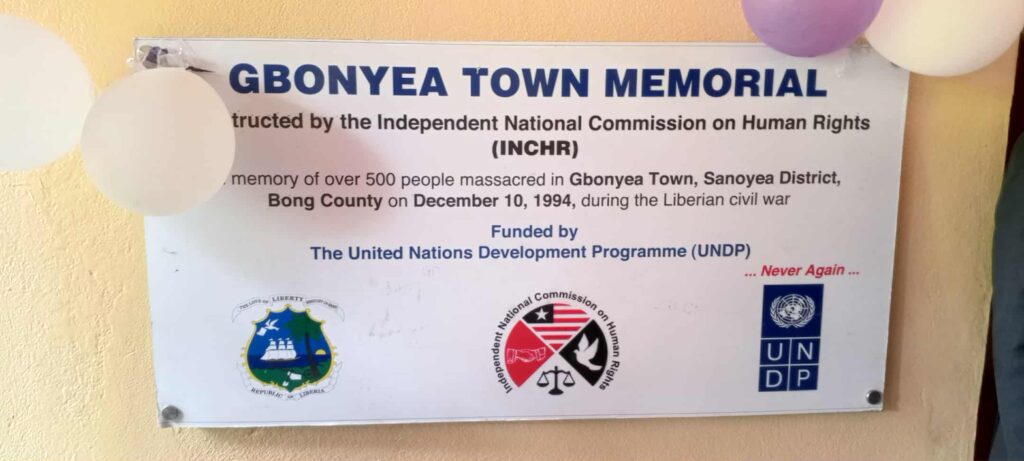
Gbonyea, Bong County: A new memorial honoring more than 500 victims of the 1994 Gbonyea massacre was officially unveiled this week, as national and international voices renewed calls for the long-delayed establishment of a War and Economic Crimes Court in Liberia.
Funded by the United Nations Development Programme (UNDP) and implemented by the Independent National Commission on Human Rights (INCHR), the US$31,000 memorial is seen as both a tribute to the victims and a powerful symbol in the fight for justice and accountability.
“This memorial is not just a structure it is justice in motion,” said Cllr. Fredrick L.M. Gbemie, Director of Operations for the Office for the Establishment of a War and Economic Crimes Court. “It sends a message that the victims of Liberia’s brutal civil wars will not be forgotten.”
Gbemie reaffirmed the government’s pledge to establish the court, stating it would be fully operational by November 2027. He stressed that the court is a moral obligation to victims, not merely an international requirement.
INCHR Chairperson Dempster Brown echoed that sentiment, directly linking the Gbonyea massacre to the broader need for justice. “The killers of our people must be held accountable,” Brown declared. “This memorial is a first step but the War and Economic Crimes Court is the justice they deserve.”
Brown criticized Liberia’s legislature, accusing some lawmakers of deliberately blocking the court’s creation due to their own alleged involvement in wartime atrocities. He cited newly documented mass graves now totaling more than 334 across the country as further evidence of the scale of wartime crimes.
Also speaking at the event, Caroline Da Silva Sousa, Human Rights Officer with the UN Office of the High Commissioner for Human Rights, emphasized the role of memorials in transitional justice.
“This memorial is part of a broader effort to ensure truth, justice, and non-repetition,” she said. “It honors the victims and reinforces Liberia’s obligation to uphold human dignity.” Sousa noted the symbolism of the Gbonyea massacre, which occurred on December 10, 1994 International Human Rights Day transforming a global day of celebration into a moment of national tragedy.
Local leaders and residents of Gbonyea, including youth, women’s groups, and Bong County officials, welcomed the memorial and called on the government to act swiftly on the Truth and Reconciliation Commission’s (TRC) recommendations.
Representing local authorities, County Administrative Officer Sam Elliott said the memorial will serve as both a place of mourning and a lasting reminder of the need to end impunity.
At the conclusion of the ceremony, Brown formally handed over the memorial to the town’s elders, urging them to protect its sanctity. “This is a sacred place,” he said. “Let it be a space for healing, remembrance, and resilience.”
Liberia’s civil conflicts between 1989 and 2003 claimed an estimated 250,000 lives. Although the TRC submitted its final report in 2009 recommending prosecutions for war crimes and economic crimes, successive governments have failed to act.
With the Gbonyea memorial now standing as a permanent reminder, pressure is mounting once again to ensure justice is not delayed any longer.
About The Author