“This Report Should Not Just Lie on the Shelf”: Officials Push for Decision-Making on CENTAL’s 2025 Corruption Report
By: Laymah Kollie
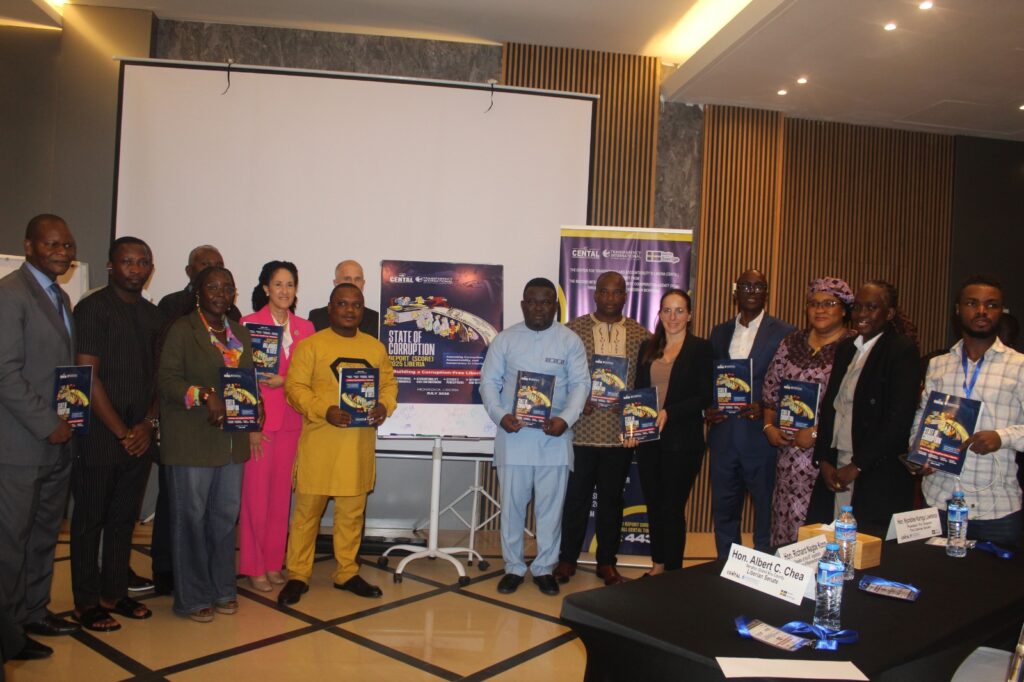
MONROVIA, July 8,2026 – Development partners and anti-corruption advocates have urged the Government of Liberia to ensure that the findings of the Center for Transparency and Accountability in Liberia (CENTAL)’s 2025 State of Corruption Report (SCORE) are translated into concrete policies and actions rather than being left on office shelves.
The call was made Wednesday during the official launch of the report at the Royal Grand Hotel in Monrovia, where speakers emphasized that corruption continues to undermine governance, public service delivery and national development, despite signs of modest progress in some areas.
Delivering an overview of the report, CENTAL Executive Director Anderson Miamen said the 2025 State of Corruption Report provides a comprehensive assessment of Liberia’s anti-corruption landscape through a nationwide citizens’ survey, key informant interviews, media monitoring and reviews of institutional reports and policy documents.
The survey was conducted in nine of Liberia’s fifteen counties, including Nimba, Bong, Grand Cape Mount, Margibi, Bomi, Gbarpolu, River Cess, Montserrado and Bassa counties.
Presenting the report, Cllr. Gerald D. Yeakula, Consultant and Chejuah Rogget Chea, Program Manager at CENTAL explained that the report presents a mixed picture of Liberia’s fight against corruption, highlighting some institutional gains while exposing persistent weaknesses in accountability, enforcement and public confidence.
According to them, although the report recorded a modest decline in the number of citizens who perceive corruption to be widespread and fewer respondents admitted paying bribes compared to previous years, corruption remains deeply rooted across key public institutions.
The report identifies the police, medical services and the courts as the three public institutions most vulnerable to corruption, while public confidence in integrity institutions remains lower than confidence in religious institutions and the media.
“The report reflects both progress and persistent challenges. Liberia has strengthened some accountability mechanisms, but the gap between policy commitments and actual enforcement remains the country’s greatest challenge.”
Adding, that underfunding of integrity institutions, selective accountability, delays in corruption prosecutions and limited public confidence continue to weaken the country’s anti-corruption efforts.
Vice President of the Association of Female Lawyers of Liberia (AFELL), Cllr. Bowoulo T. Kelley stressed that the success of the report should not be measured by the launch ceremony but by the actions government takes afterward.
“The true value of the report is not measured by what is being said today. SCORE 2025 must be more than a document on a shelf. “Its value will be determined by the policies enacted and the actions taken to reduce corruption using its recommendations.” Kelley said.
Furthermore, Montserrado County District 6 Representative Moima Briggs Mensah called for corruption reports to identify individuals responsible for corrupt practices instead of making broad institutional accusations.
According to the lawmaker, identifying specific offenders would improve accountability and prevent innocent public servants from being unfairly associated with corruption.
“Let the report not just look at the Legislature in general, but identify the lawmakers involved, the office staff practicing corruption and even the security officer at the gate if necessary. That way, everyone will know exactly where the problem exists.”
She argued that naming individuals rather than institutions would support efforts to combat corruption and make enforcement more effective.
The report comes at a time when Liberia continues efforts to strengthen transparency and accountability through several integrity institutions.
CENTAL’s 2025 State of Corruption Report notes that the Liberia Anti-Corruption Commission (LACC) received 44 corruption cases during the reporting period, completed 27 investigations, secured 12 indictments and obtained three convictions.
The report also highlights significant audit findings by the General Auditing Commission (GAC), revealing financial management irregularities across several public institutions, while only 37 percent of audit recommendations made to 62 government entities were implemented.
Its further points to improved asset declaration compliance, with the LACC reporting 91 percent compliance across the three branches of government following increased enforcement measures.
Despite these developments, the report concludes that judicial delays, inadequate funding for integrity institutions, selective enforcement of anti-corruption laws and limited public reporting of corruption continue to hamper Liberia’s anti-corruption agenda.
Meanwhile, development partners renewed calls for government authorities to use the report as a practical policy tool.
Representatives of the Embassy of Sweden, the United Nations, the United States Embassy and other international partners echoed the need for evidence-based decision-making, emphasizing that reports of this nature should guide reforms rather than simply become reference documents.
The partners said Liberia’s anti-corruption efforts will only produce meaningful results when the findings and recommendations contained in reports such as SCORE are integrated into government planning, legislative reforms and institutional accountability measures.
They urged policymakers to use the report to strengthen governance, improve public sector accountability and reinforce public confidence in the country’s integrity institutions.
About The Author