NEC Launches Strategic Plan, Seeks Over US$75M to Strengthen Liberia’s Electoral System
By Lazota Bility
Monrovia, September 7,2026: National Elections Commission (NEC) has launched its 2026–2030 Strategic Plan, which is expected to require more than US$75 million over five years to strengthen Liberia’s electoral system and prepare for 2029 General Elections and future electoral cycles.
NEC 2026–2030 Strategic Plan was developed as a forward-looking plan of action to guide Commission’s priorities, reforms and investments through next electoral cycle, including 2029 General Elections.
The Plan builds on achievements of 2018–2024 Strategic Plan and aligns with Liberia’s national development priorities, including Agriculture, Roads, Rule of Law, Education, Sanitation and Tourism (ARREST) Agenda for Inclusive Development (AAID), regional democratic commitments and global good governance practices.
It outlines NEC’s vision of becoming an independent, professional and technology-driven Election Management Body that delivers credible, inclusive and transparent elections.
NEC’s Plan focuses on six key areas, including legal and policy reform, financial sustainability, institutional capacity, digital transformation, stakeholder engagement, gender and social inclusion, as well as electoral preparation and operational efficiency.
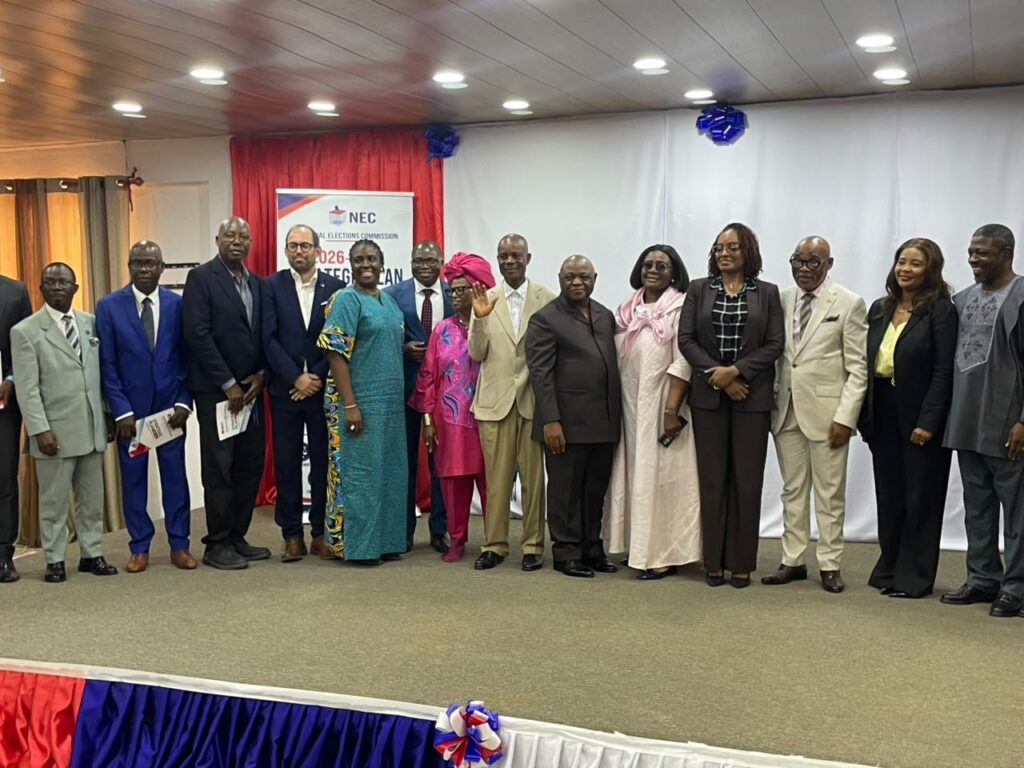
Launching the 2026-2030 Strategic Plan on Wednesday in Sinkor Monrovia Liberia
NEC Chairperson Hon. Jonathan K. Weedor described it as “a bold new chapter in Liberia’s democratic evolution.”
He said the Strategic plan is more than a document, but a deliberate effort to strengthen Liberia’s democratic institutions and protect every vote as an expression of people’s will.
Weedor said changing electoral environment, driven by digital technology, shifting demographics and increasing demands for transparency, requires NEC to modernize its systems.
He added that lessons from previous strategic plan exposed gaps in technological infrastructure, financial sustainability and institutional efficiency.
Presenting the strategic plan, NEC Director of Monitoring and Evaluation Michael A. Clarke Sr. said Commission will seek to modernize electoral laws, strengthen dispute resolution and complete constituency delimitation to promote equitable representation.
Clarke also stressed need for predictable funding, saying NEC should move toward “electoral-cycle-based financing” to ensure resources are available ahead of planned electoral activities.
He said plan also focuses on establishment of an Electoral Training Institute, stronger human-resource capacity, digitization of electoral systems and improved cybersecurity, while expanding civic education and participation of women, youth and persons with disabilities.
The launch brought together Commissioners , Representatives, International partners, NGOs ,CSO and political party observers.
Also speaking, ECOWAS Representative Mohammed K. Konneh welcomed plan but cautioned NEC to remain flexible because electoral situations can change unexpectedly.
He urged Commission to “respond quickly, adapt to emerging situations, and solve unexpected electoral challenges,” saying adaptability is important for an effective electoral management body.
Konneh reaffirmed ECOWAS’ partnership with Liberia and called for cooperation among government, political parties, civil society, media and development partners.
For his part, UNDP Resident Representative Louis Kuukpen placed public trust at center of electoral process, reflecting on Liberia’s peaceful and credible 2023 elections.
“Credibility is not an event. It is a habit,” Kuukpen said, challenging NEC to maintain public confidence even when elections are not taking place.
He also urged Commission to address exclusion of women, youth, persons with disabilities and other marginalized groups, while preparing for growing threat of misinformation, disinformation, deepfakes and AI-generated content.
UN Women representative highlighted continued barriers to women’s participation in political leadership, referencing findings from 2024 NEC Gender Audit.
She noted that women’s participation remains stronger “as voters than as political candidates and leaders,” stressing need to address structural barriers and increase women’s representation within NEC leadership and electoral staff.
She also called for continued preparation of both women and men ahead of elections and greater public understanding of electoral rules and regulations.
With implementation projected to cost more than US$75 million, Weedor described required funding as an investment in Liberia’s democratic future.
“This is not merely an expenditure; it is an investment in the soul of our democracy,” he said, linking investment to Liberia’s peace, stability and governance.
NEC has established a Strategic Plan Steering Committee, technical working groups and quarterly review mechanisms to monitor implementation and measure progress.
Commission has also identified funding uncertainty, political polarization, misinformation, cybersecurity threats, infrastructure constraints, election security and climate-related disruptions, including flooding, as risks to implementation.
Commissioner Weedor stressed that NEC cannot implement plan alone, saying “electoral preparation is a shared national responsibility.”
Adding strategic plan is intended to build an independent, professional, inclusive and modern electoral institution capable of meeting Liberia’s democratic needs ahead of 2029 General Elections and beyond.
About The Author